Showing posts with label Israel Egypt Jordan Trip. Show all posts

Sunday, May 15, 2011

The Trip of a Lifetime! (Days 16 & 17)

Saturday, May 14th

The next day we said goodbye to the Red Sea Resort and got on the bus one final time to travel out of Egypt and back to Israel to the Tel Aviv Airport - a trip that took around six hours.

A view of the Red Sea as we drove out of Taba, Egypt.  The water was so beautiful...

Here you can see the coral reef that winds around the shores of the Red Sea...

One last view of the Castle of Saladin...

We had another red-eye flight going home that left around midnight.  I think everyone slept quite a bit on that flight - we were all VERY tired.  We were also SUPER excited to get home to our four kids.  We missed them like crazy!!

Here are some of the fun things we picked up on our trip to remember where we had been:

We bought this from one of the Bedouin men selling souvenirs by the Royal Tombs in Petra.

This was the necklace and bracelet I bought from the bedouin lady for Morgan...

This flute was made out of a reed of some kind.  When we were walking through the Roman ruins at Jerash, Jordan we bought one for each of our kids from a man walking around selling them.

We brought home money for our kids from each of the three countries we visited - Jordan, Israel, and Egypt...

I got this outside the Church of the Nativity in Bethlehem.  I thought it would be fun to use around Christmas time.

A lady in Bethlehem makes these Bethlehem Baby Blankets.  We got one for each of our children to save and use for blessing their babies when they have children of their own...

I got this beautiful handmade leather bag in a shop in old town Jerusalem.  I thought it would be fun to use for church.

This is an actual ancient coin we bought that is from the time of Christ called a mite.  This is actually about 2,000 years old.  It was worth the least amount at that time of any coin.  This is the type of coin talked about in the New Testament in the story of "the widow's mite" (Mark 12:41-44)

I wanted to bring something back for my children, family members, and the kids in my Primary.  We have 160 kids in Primary so it had to be small, lightweight, and inexpensive.  I had the idea of bringing them back an olive leaf from the olive trees in the Garden of Gethsemane.  I attached it to a bookmark I made and laminated them.  The words on the bookmark are to a song our family loves called "Gethsemane".

We were also able to buy olive oil in Jerusalem and then have Mark consecrate it in the Garden of Gethsemane.  We used it as a special gift to some of our friends and family.  The tag we attached is a picture I took in a grove of 2,000 year old olive trees in the Garden of Gethsemane.

So many of the locals wore these scarf looking things over their heads, styled either like Kyle and Colton (loosely draped over their head with the black thing to hold it in place), or like Bryan (wrapped around the head with the edges tucked in and the rest draping down their back).  Kyle and Colton are also holding their slingshots made like the one David would have used to fight Goliath.

We brought each of our boys a slingshot styled after the kind David used to fight Goliath... 

The bright green little scarf tied around Morgan's waist we bought on the streets in Bethlehem.  The pink scarf around her head, the blue skirt, and the earrings were bought at a little shop in old town Jerusalem.

The shopkeeper said the earrings are made from actual Arabic coins and are meant to attract men.  We don't want those earrings to do their job for quite a few more years!

Mark had this ring made while we were in Israel.  On the outside he had it say "Return With Honor".  For those who might be unfamiliar with this saying, it refers to returning to our Heavenly Father with honor - not doing anything that would make him not be proud of us.  On the inside it says "Jerusalem 2011".

I got this necklace at a shop in Israel that caters to a lot of BYU Jerusalem Center students.  It is a Liahona - the ball that directed Nephi and his family when they left Jerusalem in 600 BC to journey to the Promised Land here in the Americas.  (1 Nephi)

These are recreations of the ancient oil lamps used at the time of Christ.  We brought back one for each of our kids and talked about letting their light shine and setting a good example.  We also talked about the story of the 10 virgins and its significance about being prepared.

This is probably the purchase we were the most excited about.  This is an actual ancient oil lamp and a cruse that would have been used to fill it.  They are actually 2,000 years old!  We got them in Jerusalem.  John Lund has a lot of experience with antiquities and helped anyone who wanted them to get the real deal.  We were really worried about getting them home in one piece - but we did.

This is an alabaster vase containing Spikenard that we purchased in Israel.  The significance of this is found in the New Testament (Mark 14:3) where it talks about an alabaster box with the spikenard.  The spikenard smells really good!  These are the types of things that were being made in places like the alabaster factory we visited in Luxor, Egypt.


This is a pottery shard we found while walking around the archaeological dig in Beit Lehi (in Israel).  There were lots of them scattered all over the hillsides.

We purchased the next four pieces at a shop in Old Town Jerusalem.  There are several that cater to BYU students with pieces of significance to members of our church.  We loved these pieces because they were all made of olive wood from the area.  This statue of Christ was special to us because it portrays him smiling.

This eagle was significant to Mark because he is an Eagle Scout.  As each of our boys gets their Eagle he plans to add their name to a plaque at the bottom of the eagle.

This is a carving of the Liahona talked about in 1 Nephi of the Book of Mormon (1 Nephi 16).

We bought these because of the significance of the story of the "Loaves and the Fishes" (Matthew 14).

This lamp didn't have any biblical significance, but I just loved it!

I had this Egyptian cartouche necklace and bracelet made while we were in Egypt.  The necklace has my name in hieroglyphics.  Here are the meanings of each:

D - helping hand
A - eagle of courage
N - waters of life
E - feather of truth and justice
T - loaf of bread
T - (above)
E - (above)

The bracelet has the first initial of each of my children in hieroglyphics.

B - leg (likes walking/wandering/activities)
M - owl of wisdom
C - stick (dependent)
K - basket (likes collecting anything)

We haggled with a shopkeeper for the two headpieces pictured below outside the Muhammad Ali Mosque in Cairo, Egypt...


As I sit here after our trip writing about what we saw and felt, I have had opportunity to relive it.  What I appreciate most about this trip are the feelings I experienced as I stood on sacred ground - sacred because our Savior was there.  Those feelings come from my testimony of my Heavenly Father and his son Jesus Christ.  I am so grateful for the life of my Savior, Jesus Christ.  I am so thankful for my family.  I am so thankful for my membership in the Church of Jesus Christ of Latter-Day Saints.  It is so nice to know where I came from, why I am here, and where I am going.  I know my Heavenly Father loves me and is aware of me each and every day.  This trip allowed us to be in the places Christ lived and walked 2,000 years ago, but we are also blessed to be able to talk to a loving Father in Heaven every single day.  He is always there for us and am eternally grateful to Him and to his Son. 

Friday, May 13, 2011

The Trip of a Lifetime! (Day 15)

Friday, May 13th

Our time of touring was at an end.  This last entire day was spent relaxing at our five-star Marriott Red Sea Beach Resort.  We were all EXHAUSTED - but in a good way.  We were able to see SO much on this trip.  I will remember it forever.
We started the day with some volleyball on the beach.  Then Mark and I went snorkeling with Jace and Zac in some of the prettiest coral reefs in the world.  I always thought the beautiful colors you see in the ocean in the Disney movie "Finding Nemo" were exaggerated - they weren't!  It was absolutely gorgeous down there - bright and colorful!  We saw so many huge beautiful schools of fish that were so close you could reach out and touch them.  We also saw eels.  There were so many beautiful corals to see.  We swam about 1/2 mile in about an hour.  I was pretty tired when we got out, but it was so worth it!

We swam in the huge beautiful pool below that wraps around through the resort with beautiful caves and waterfalls.  And we treated ourselves to yummy ice cream cones.


The Trip of a Lifetime! (Day 14)

Thursday, May 12th

This was the view of our hotel as we waited behind it to step onto our boat for a ride on the River Nile this morning...

To me this was a much calmer and beautiful place in comparison with the hustle and bustle of the big city of Cairo.

We were excited to be able to say we had been on the River Nile...

 After our peaceful ride on the Nile we traveled to the Valley of the Kings.  I took the picture below as we traveled.  In the distance, at the base of the mountain you can see the temple of Queen Hatshepsut.  Hatshepsut (1508–1458 BC) was the fifth pharaoh of the eighteenth dynasty of Ancient Egypt.  She is generally regarded by Egyptologists as one of the most successful pharaohs, reigning longer than any other woman of an indigenous Egyptian dynasty.

As we neared the Valley of the Kings we could see all kinds of caves dug into the mountainside.  The Valley of the Kings was for royalty, but there are tons of other burial caves all along the hillsides in the area...


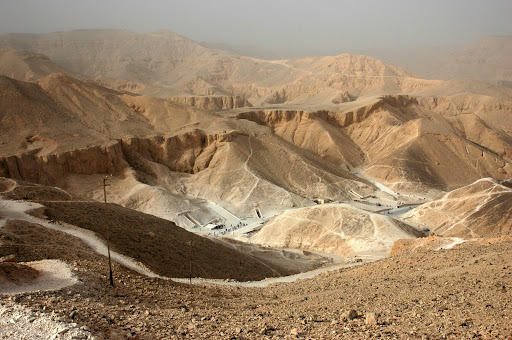
The Valley of the Kings lies in a deep ravine of the limestone hills of Qurna.  Some of Egypt's most famous personalities were buried in the valley of the kings and the valley of the queens.  It was here that Howard Carter discovered the only unmolested tomb of the pharaohs with its untouched treasures.  This was the tomb of King Tut (Tutankhamen) who was found buried in a solid gold coffin weighing 2,448 pounds.

It was also here that Antonio Lebolo stumbled onto a pit tomb in which were hundreds of mummies.  he shipped out 11 mummies in 1823 and these ended up in the custody of Lebolo's nephew, Michael Chandler, who discovered that wo papyrus scrolls were with the mummies.  These were found to be the writings of Abraham and Joseph.  The Church of Jesus Christ of Latter-Day Saints  bought the scrolls and four of the mummies and Joseph Smith translated and published part of the Abraham scroll before he was martyred.

The valley is surrounded by high cliffs, dominated by a natural pyramid shaped peak.  The kings found that pyramids didn't provide enough protection against grave robbers, so King Thutmosis I was the first to choose this location for his burial.  The only entry to this place was a long narrow winding entrance.  He had the workers blindfolded so no one would know the location of his tomb, and placed sentries at the entrance in the hope of discouraging tomb robbers.  His successors followed his lead, having their tombs dug in this extraordinary valley.  This cemetery contains sixty two tombs, although not all of them are royal.  In fact there are two valleys in the western hills that make up the Theban Necropolis for royal burials: the East and the West Valleys.

Once again this was a place where no cameras were allowed.  I had to leave it on the bus, so the four pictures below were pulled from the internet.

A view from above the Valley of the Kings...

These three pictures are from inside several of the tombs.  There were so many beautiful paintings and hieroglyphics on the tomb walls - and they are all original, not restored.  It's so amazing how bright and colorful the colors were even after thousands of years.


After leaving the Valley of the Kings we went to an Alabaster Factory.  These men sit here all day making all kinds of beautiful alabaster pottery and products...

This little girl was hanging around the factory with some other children.  She was so darling.  I took her picture and showed it to her - she was so excited! 

This little boy was her brother.  I pulled out two quarters and gave one to each of them.  I was instantly surrounded by about 10 other kids 
who also wanted quarters.

The remains of another ancient Egyptian monument - originally pretty large judging by the feet... 

A local with her sheep...

Next we visited Medinet Habu, the name commonly given to the Mortuary Temple of Ramses III.  Ramses III had this temple constructed during his reign (1186-1155 BC).  Mortuary temples (or memorial temples) were temples constructed adjacent to, or in the vicinity of, royal tombs in ancient Egypt.  Once the New Kingdom pharaohs began constructing tombs in the Valley of the Kings, they built their mortuary temples separately and away from the tombs.  The temples were designed to commemorate the reign of the pharaoh by whom they were built, as well as for use by the pharaoh's cult after death.  A pharaoh would usually start having their temple built immediately upon beginning their reign.  Building would keep on going until their death - which is why there are sign of some parts being unfinished.

This entrance was known as a migdol - which was a fortified gate-house.


Cute tourist again...

When we came through the gate-house we saw this smaller temple on the right.  It was built by Hatshepsut and Tuthmosis III.

This is the first pylon of the temple which shows Ramses defeating the Syrians...

Paintings on the ceiling (next 3)...


This cartouche on the ceiling is the largest cartouche found to date...


The names of both gods and kings were placed within a 
cartouche (the oval below)...

The next three pictures show an open courtyard lined with uncarved columns on one side, and colossal statues of Ramses III on the other.


 All the hieroglyphic carvings and all the color in them was amazing to me.  No one has restored any of this.  It has been like this for over 3,000 years! 

Our guides pointed out the significance of these carvings being like unto "washing and anointing"...


On our way to Karnak temple we stopped to see these huge statues standing in what seemed to be the middle of nowhere... 

Bedouins out with their flocks...

These fields reminded Mark of Ruth out in the fields gleaning wheat...

Our next stop was Karnak Temple which has stood for over 4,000 years!

The temple of Karnak was known as Ipet-isut (most select of places) by the ancient Egyptians.  It is a city of temples built over 2000 years and dedicated to the Theben triad of Amun, Mut and Khonsu.


This derelict place is still capable of overshadowing many of the wonders of the modern world, and in its day must have been awe inspiring.  For the largely uneducated ancient Egyptian population this could only have been the place of the gods.  It is the mother of all religious buildings, the largest ever made, and a place of pilgrimage for nearly 4,000 years.

It covers about 200 acres.  It is the largest temple complex ever built by man, and represents the combined achievement of many generations of ancient builders.  The area of the sacred enclosure of Amun alone is 61 acres, and would hold ten average-sized European cathedrals.

Below we saw the First Pylon (the main entrance) of the temple.  The avenue of ram-headed sphinxes leading to the first pylon was built by the Ethiopian kings (656 BC).  The ram-headed sphinx is a symbol of the god Amun.  Originally there were three avenues of sphinxes one of which, two miles long, linked up with the avenue of human-headed sphinxes of the temple of Luxor.


As we passed through the first pylon we came to the first courtyard lined with columns and ram-headed sphinxes...

In the courtyard was this HUGE (50 foot tall) statue of Ramses II...

The majority of the hieroglyphics we saw were carved into the stone, but in the instance below, the hieroglyphics were raised - the surrounding stone was carved away to leave only the symbol...

The four pictures below are of the Hypostyle Hall.  It was built between 1294 and 1213 BC.  At 54,000 square feet, and with its 134 columns (the tallest of the 134 columns reaches a height of 75 1/2 feet) is still the largest room of any religious building in the world.  In this enormous forest of columns you get a genuine feeling of the wealth of the New Kingdom and of the importance of Amun as the State-God.  The Hippostyle Hall was started by Seti I, but the majority of the construction was done by Ramses II.  The center columns are taller than the others, and the windows would allow light to come in.
 

 In the upper part of both the pictures above and below you can see the where the windows would have been to fill this room with light.  It had to be so magnificent in its day!!


The Pink Obelisk of Hatshepsut (97 feet high and weighs 320 tons) is to the left, and the one to the right was erected by Tuthmosis I (74 feet high and between 143 and 160 tons).

Another view of the Pink Obelisk of Hatshepsut... 

Behind Mark you can see the temple of Amon-Ra to the far left, the obelisk of Tuthmosis I in the center, and the obelisk of Queen Hatshepsut to the right...

Standing guard at the entrance below are two statues of Ramses II.  The lady walking through the picture gives you an idea of the size of these statues...

 So much of it is gone, but this was the Temple of Amon-Ra.  It was monumental in size.


A closer look at Queen Hatshepsut's obelisk...

Mark's dad is so kind.  These locals followed him for quite some time...all the way back to the bus, trying to sell him whatever trinkets they could.  You can tell by the smile on his face that he always keeps a great attitude.

Our last stop of the day was Luxor Temple.  It was founded in 1400 BC and lies close to the Nile and parallel with the riverbank.  The earliest parts of the temple still standing are the baroque chapels, just behind the first pylon.  They were built by Hatshepsut, and appropriated by Tuthmosis III.  The main part of the temple - the colonnade and the sun court were built by Amenhotep III, and a later addition by Rameses II, who built the entrance pylon, and the two obelisks (one of which was taken to France, and is now at the centre of the Place de la Concorde) linked the Hatshepsut buildings with the main temple.

Hundreds of these sphinxes once lined the road to the entrance of Luxor Temple...

This is the entrance to the temple...


The central corridor of the temple.  You can see the huge statue of 
Rameses II sitting in the distance.

A baroque chapel built by Queen Hatshepsut...

Next in Luxor temple is the great Court of Rameses II.  This is the same Pharaoh who went up against Moses when Moses led the children of Israel out of Egypt...

Statues of the Pharaoh and Queen 
(most likely Tutankhamon and his wife Anchesenamon)...

Proceeding further through the temple we came to the Court of Amenhotep III with these amazing papyrus columns arranged in four rows of eight columns...

From Luxor Temple we drove back to the airport to fly back to Taba and our resort hotel on the Red Sea.